
There are four occurrences of the finishing the sentence:
"...till Daleth, mahomahouma, who oped it closeth thereof the. Dor." [020.18]
"Wold Forrester Farley who, in deesperation of deispiration at the diasporation of his diesparation, was found of the round of the sound of the lound of the. Lukkedoerendunandurraskewdylooshoofermoyportertooryzooysphalnabortansporthaokansakroidverjkapakkapuk." [257.24-27]
"And that henchwench what hopped it dunneth there duft the. Duras." [334.29-30]
"Of manifest 'tis obedience and the. Flute!" [343.36]
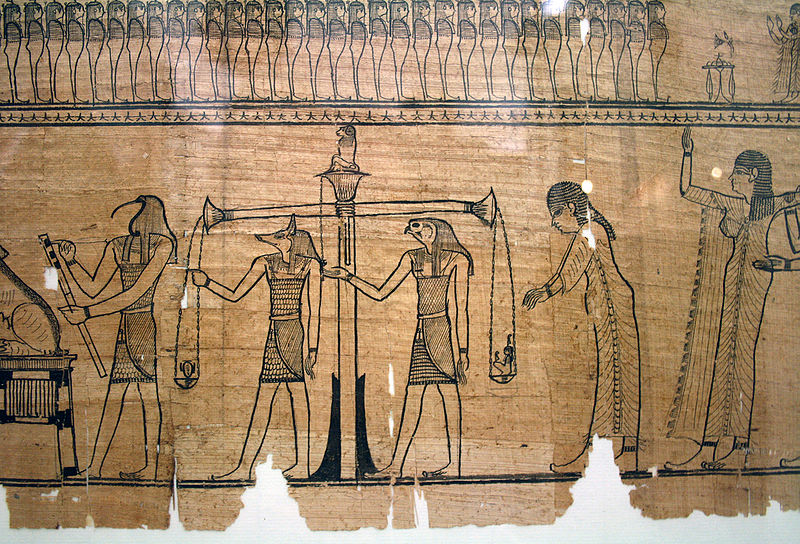
the at the end of FW is "going out" on final journey - certainly not intended for getting back to the first page. As we pass through the door, we are facing vignette from the Book of Dead, distorted by spilled tea:
Vignette represents Nut and Geb as night sky and earth. In Draconian current of
ancient Egypt (as in later Vama Marg tantric tradition), picture represents
"kalas" or emanations of stars which initiate imbibes (in this case, Geb,
reclined below). In FW image is distorted since tea was spilled on vignette at
the end of the book, but that same tea represents those kalas, which are quite
sexual. As those kalas are not always healthy, Earwicker has some problems
throughout the book (or, in other phraseology, because of indigestion of certain "elixir").
In chapter 3.4, page 582, we have: "no end of slow poison... as long as ever
there's wagtail surtaxed to a testcase on enver a man." Wagtail is story after
the the and those instances, spread throughout the book, are intended to
assist a dead person's journey through the Duat, or underworld, and into the
afterlife until he emerges forth into the Light.
Chapter 3.4, set as stage, is rehearsal of the final journey, so it has many aspects of most advanced stages in lucid dreaming. For instance, consciousness of initiate is segmented so that when he is "synchronized" with one dream, he automatically opens another, staying all the "time" in the first dream, then he opens third staying simultaneously in second and first one, a.s.o. There is no need to go to sleep in any one of the dreams, but if wished, initiate can survey all his bodies as sleeping in different "places" and in different poses/stages of dream. End result is partitioned consciousness like figures on chess board, which are under control of, and which are in fact parts of, "magnificent body", which ancient Egyptians called Sahu. In Ulysses, Parnel's brother plays chess and his body parts are described as subjects: i.e. "beard and gaze hung on a chessboard" and "John Howard Parnell translated a white bishop quietly and his grey claw went up again to his forehead whereat it rested. An instant after, under its screen, his eyes looked quickly, ghostbright, at his foe and fell once more upon a working corner." But not only parts of chess player's body is Joyce trying to synchronize, but also persons and situations - that is sign of presence of Sahu. Castaneda in his Art of Dreaming described only four gates of dreaming, which follow pattern from first 3 chapters of Book 3 (4th gate is when initiate falls asleep in a dream, which is what Shaun does on a hilltop at the beginning of 3.3). Castaneda didn't describe last three gates, but we have them in Chapter 3.4. Final stages of lucid dreaming, when "unsuccessful", make basis of the myth of Osiris (and ballad of Humpty Dumpty!) and on the first page of FW we have parts of Osiris' body scattered on the landscape. Goal of FW is not getting to the first page after the the, but synchronization of those parts in one functional entity, Sahu, or Magnificent Body: an adept in self-regulated "movement" along the continuum of consciousness - consciousness which is in FW represented by Porter.
Let's examine Earwicker's room as described in 3.4, and fancy it as queen's
chamber of Great pyramid (same as King's, not meant for burial but for
initiation):
"North, wall with window practicable. Argentine in casement. Vamp. Pelmit above.
No curtains. Blind drawn. South, party wall."
Or in first draft version:
"North wall with window, practicable [no curtain, blind drawn]. South wall."
So north is practicable, although shaft has white limestone block ending it
(blind drawn). North shaft is aligned with Thuban, in the constellation of Draco
(Typhon) - tradition of Mother goddess and her son, Set (Shut!): Shem. Carlos
Castaneda in first chapter of Second Ring of Power have symbolic description
of that ancient tradition. All elements are there: Dona Soledad, her dog, room oriented towards the north, position with woman on top,
rising of the Fire Snake through the top of the head...
Joyce describes Ana as "brahming" through a feedchute to feed HCE when he is unwell; that feedchute is the north shaft of the Pyramid - through it, she is sending healthy emanations from the stars.
South shaft, for Joyce, is wall (although in reality it is
same as north one). South shaft is aligned with Orion, and that tradition is
Osirian (father God, son Horus, and in later phases Gnostic Christianity).
Typhonian and Osirian (Set/Horus or Shem/Shaun) currents are in conflict from
time immemorial and in human anatomy first is chakra at the bottom of the spine
and second is chakra at the top of the head - from there Joyce draws his
Butt/Taff(chief (head)) stuff. For adept to attain Sahu, war of those two
currents have to be made peace. In Draconian
tradition, Fire Snake once risen to the top of the head, should retreat down to
its base at the bottom of the spine: in chapter 3.4 E&A go to the children's
room upstairs and then retreat to their room - that is also rehearsal of final
journey: that moment in space/time when twins are quite young, when Ana's green
gown is quite new, all with sex which ensues (first cause of their fall) - that
is closest point that we can get to "real" ALP and HCE and their Sahu bodies. Robert Masters wrote: by "raising Kundalini" -- which only the SAHU can
do, although lower bodies counterfeit the experience -- the brain of the
physical body is altered and much more of it comes into use, increasing the
powers of all the bodies. Then the SAHU, if proper Work is done, can acquire
SEKHEM (Power or Might). Sekhem is mentioned in 3.4, together with some of the
other Egyptian bodies and energies: Khaibit, and "wadji" (hedjes).
Even more interesting is that Dubliners
already have construction of Wake and Sahu as final goal. For instance, The Dead and
Sisters are
connected: Sisters are two
Joyce's great aunts (Annie and Elizabeth), and second
pair consists of Miss Kate and Miss Julia (Ellen Mary and Julia Clare) - those are Four Old Men from FW (a lone a
last a loved a long). Gretta Conroy is Margaret or "Maggy" who sends letter to
poor father Michael - father Flynn combined with Michael Furey. Paralysis of
father Flynn is exactly the same as paralysis of Earwicker and origin of his fall is also the same as HCE's
- mystery hidden in the title
of the first story, Sisters. "My dear sisters in Christ are you ready for
confession?" is sentence taken from THE PRIEST, THE WOMAN
AND THE CONFESSIONAL, by Charles Chiniquy. Special gem is Lily, caretaker's
daughter, who becomes Sackerson (Lally) in FW - that is missing apostrophe (')s in Finnegans
Wake, and also hint to symbolic raising of Fire Snake which should be
accomplished after the. Gabriel's fall at the end of Dubliners is hidden in
story about shaman's ascension to heaven (Henaro's description of aftermath of
his experience with ally at the end of Journey to Ixtlan): on heavenly banquet
shaman should sustain from partaking of even a morsel of food - as we may see,
in The Dead Gabriel carves the goose before him (Osiris?), eats of it and
later becomes a
ghost beside his wife. Same as chapter 3.4 in FW, Grace is rehearsal for final journey in
Dubliners - Tim Kernan is fallen TM creator, and his
four friends (for instance, "ah poor old Mathew Callanan": Martin Cunningham:
Matthew) try to help him.
And on stage of Jesuit Church we have father Purdon: not sick priest, but
powerful red figure; suggestion of brothel, but more likely of Red Samadhi,
"confessional" sessions, simony and other sins notwithstanding. It seems that same ways which
lead to hell also lead to heaven, but:
"For the children of this world are wiser in their generation than the children
of light. Wherefore make unto yourselves friends out of the mammon of iniquity
so that when you die they may receive you into everlasting dwellings." Those
everlasting dwellings are in Aaru or 'Field of Reeds', in eternal light after the the.
Only souls who weighed exactly the same as the feather of the goddess Ma'at were
allowed to start a long and perilous journey to Aaru, where they would exist in
pleasure for all eternity. Castaneda in in Tales of Power cites don Huan:
"In your case, as in the case of every man, your imbalance was due to the sum
total of all your actions". Final epistle of father Purdon is exactly the same: "Well, I have looked into my
accounts. I find this wrong and this wrong. But, with God's grace, I will
rectify this and this. I will set right my accounts."
S.S.